 Bolli Automation specializes in vision dispensing machines_factory direct


Bolli focuses on Vision Fluid
BOLI, FOCUS ON VISION‑BASED FLUID DISPENSING
Search All
BOLI, FOCUS ON VISION‑BASED FLUID DISPENSING
Bolli Automation dispensing FAQ summarizes high-frequency questions and troubleshooting methods for vision dispensing machine selection, adhesive-valve matching, stringing and glue break, unstable accuracy, and bubble entrainment, helping engineers quickly locate and solve on-site dispensing problems.
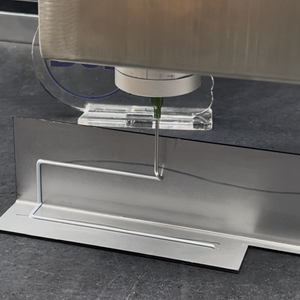
The imaging quality of the vision dispensing machine is first determined by lighting. This article explains light-source types and applicable scenarios, lighting angles and color considerations, and lighting countermeasures for reflective and dark workpieces.
Read full article
The vision dispensing machine generates large amounts of process data during operation. This article explains collected fields, communication transmission, dashboard design, and the data-closed-loop-feeding-back-to-process approach, and common pitfalls in implementation.
Read full article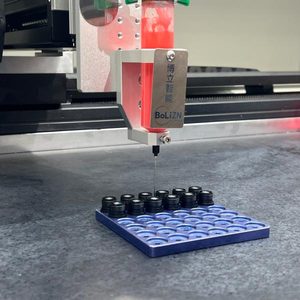
The vision dispensing machine's positioning capability is built on image matching and feature recognition. This article explains the imaging, template matching, feature recognition, and coordinate-conversion flow, and the handling ideas for common recognition difficulties such as black reflective surfaces.
Read full article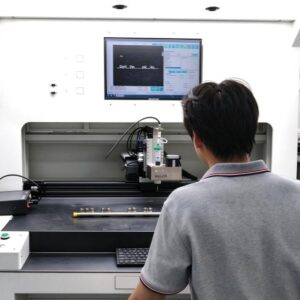
The vision dispensing machine's dispensing program and process files are core assets. This article explains four management key points—version naming, local/remote dual backup, changeover error-proofing, and permission auditing—to avoid wrong versions and loss.
Read full article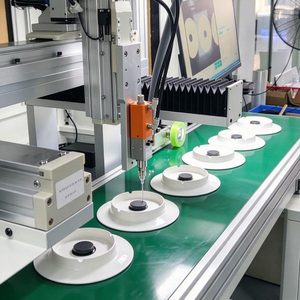
The output of the vision dispensing machine cannot be judged by yield alone; OEE measures overall efficiency as availability × performance × yield. This article explains the algorithms of the three indicators and the improvement paths of shortening changeover, reducing failures, and improving yield.
Read full article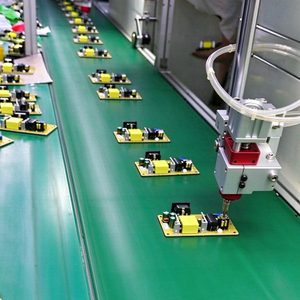
The vision dispensing machine uses fly-shooting to parallelize photographing and motion, uses buffers to smooth peaks and fill valleys, and cooperates with loading/unloading cycle matching and Vision motion coordination, turning etc. pending changes into actions to improve overall line efficiency.
Read full article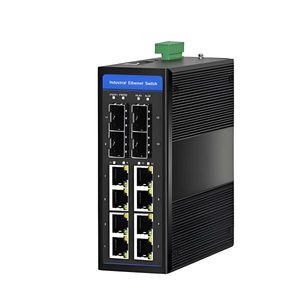
Vision dispensing machine MES communication integration is about uploading equipment production, yield, and alarm data and receiving work-order dispatch; only by choosing the right communication method, clarifying fields, and setting triggers to prevent duplicates can data turn from isolated islands into assets.
Read full article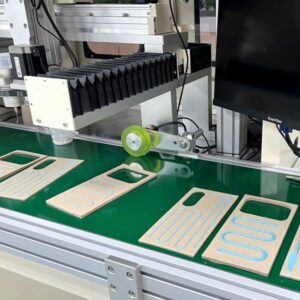
Dispensing yield is jointly determined by multiple stages: incoming material, Vision positioning, dispensing consistency, fixtures, and environment. Yield improvement should trace defects backward along the process chain rather than only focusing on equipment precision.
Read full article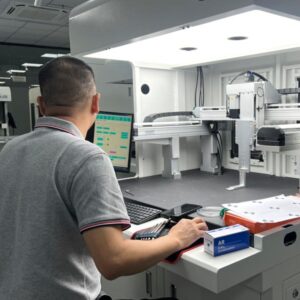
Vision dispensing machine predictive maintenance collects data such as axis temperature, valve pressure, dispensing volume, and Vision alignment deviation, builds threshold and trend models, and warns of maintenance before failure, reducing unplanned downtime.
Read full article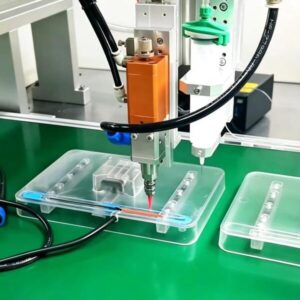
dual-component and dual-valve synchronous dispensing of a vision dispensing machine is suitable for processes requiring two adhesive materials or A/B component coordination; the core lies in stable metering ratio and synchronous control of two adhesive paths; two-component valve leans toward mixing curing, dual-valve leans toward stepwise application; before selection...
Read full article