 Bolli Automation specializes in vision dispensing machines_factory direct


Bolli focuses on Vision Fluid
BOLI, FOCUS ON VISION‑BASED FLUID DISPENSING
Search All
BOLI, FOCUS ON VISION‑BASED FLUID DISPENSING
the takt of dispensing equipment often gets stuck on "waiting": waiting for the camera to finish shooting, waiting for loading/unloading, waiting for the previous process to free up manual. Fly-shoot and buffer are exactly the solutions for these two kinds of waiting. The vision dispensing machine overlaps shooting and motion, and uses the buffer zone to cut peaks and fill valleys, so the whole-line takt can be pressed down and capacity naturally goes up.
traditional shooting requires the equipment to stop, the camera to focus, and then move to the next step; this segment is pure waiting. Fly-shoot (shooting during motion) lets the camera complete image capture while the platform is moving, and Vision processing runs parallel with motion, eliminating the pause. With a stable light source and high-speed camera, the vision dispensing machine's fly-shoot can cut the most expensive "waiting" from the single-piece takt, especially obvious for large-batch continuous production.
The buffer zone is the ”reservoir” between loading and unloading. When the current process is slow and upstream/downstream processes are fast, the buffer first catches the material to avoid the whole line being dragged to a stop. Design key points: capacity matches the takt difference, precise positioning for easy pick-and-place, no stacking or collision. Bolli's equipment can be paired with a buffer mechanism when connecting to the production line, so the dispensing segment is not frequently interrupted by upstream/downstream fluctuations.
the core of takt matching is the "short board of the barrel": the whole-line speed is determined by the slowest link. You should measureupstream and downstream cycle time, let the dispensing takt of the vision dispensing machine be slightly faster than the feeding, leaving a small buffer rather than a large backlog. Use sensors to judge presence of material and counters to prevent over-placement, avoiding empty runs or material jams. Bolli recommends including loading/unloading capacity together when making the production-line plan. Actual implementation commonly uses the three-segment "fast feeding, stable dispensing, buffer backing" approach, making the bottleneck manifest in the buffer rather than stopping the machine.
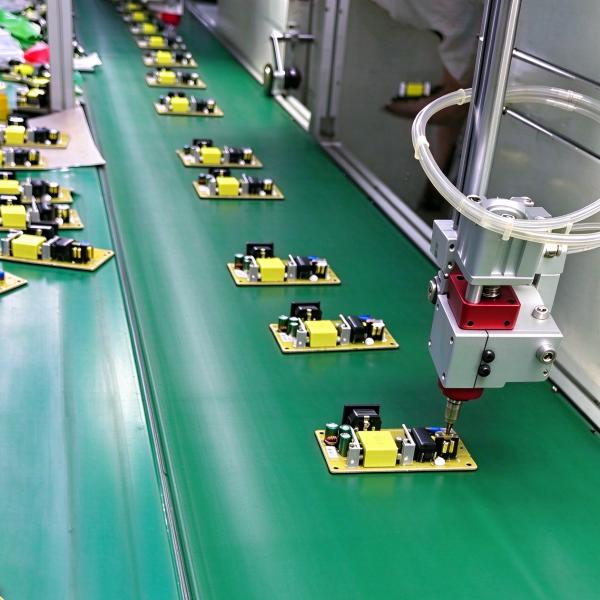
The premise of smooth flying shot isVision trigger and motion control fit seamlessly: the platform moves to the predetermined position to trigger shooting; before the image returns, the next segment of motion is already planned, and the two hand over with zero waiting. This requires the Vision algorithm delay to be controllable and the controller to have good real-time performance. The vision dispensing machine makes "shooting" and "moving" parallel, but the landing precision is still guaranteed by calibration and alignment, not deviating due to speed. At the scheme review stage,align the timing of Vision, motion, and controller across three parties, which costs less than firefighting after going live.
stuck points mostly fall into three categories: machine drift during shooting causes misalignment, fixed by recalibration and trigger calibration; buffer accumulation fixed by capacity and takt rebalancing; communication delay fixed by optimizing messages and local judgment. Make these into spot-check items, and connection problems can be found in the budding stage. The efficiency of a vision dispensing machine is often the accumulation of these details. It is recommended to review connection data weekly, turning occasional stalls into fixed spot-check items and spare-part plans.
the fly-shoot and buffer handover of a vision dispensing machine rely on"waiting" becomes "parallel", and "fluctuation" is smoothed out with a buffer: flying-scan eliminates camera pause, buffers compensate cycle-time gaps, and Vision and motion hand over with zero waiting. Making these details into inspection items keeps the whole-line capacity stable. For production-line integration advice, please call us at Phone 13352947677.