 Bolli Automation specializes in vision dispensing machines_factory direct


Bolli focuses on Vision Fluid
BOLI, FOCUS ON VISION‑BASED FLUID DISPENSING
Search All
BOLI, FOCUS ON VISION‑BASED FLUID DISPENSING
Bolli Automation dispensing FAQ summarizes high-frequency questions and troubleshooting methods for vision dispensing machine selection, adhesive-valve matching, stringing and glue break, unstable accuracy, and bubble entrainment, helping engineers quickly locate and solve on-site dispensing problems.
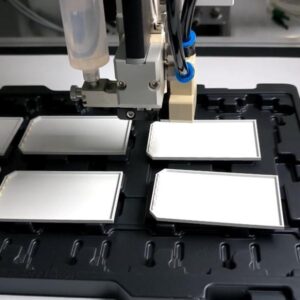
Plasma treatment removes oil film and grafts polar groups, raising PP, PE and other low surface energy plastics above the 40–42 mN/m required for adhesive bonding. Dyne pen quick screening and contact angle spot-check; transfer to the dispensing process within 4–8 hours after treatment; treat-and-dispense to avoid time-decay.
Read full article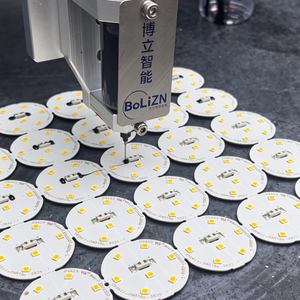
Dot pitch is derived backward from the dot diameter and overlap relationship: take the dot diameter as half the workpiece spacing, and the needle inner diameter as half the dot diameter; trial-dispense three points and fine-tune the dispensing time to converge. For sealing conditions, dot pitch should be tighter rather than looser; appearance parts value uniformity; for adhesive changes and seasonal changes use the gravimetric method...
Read full article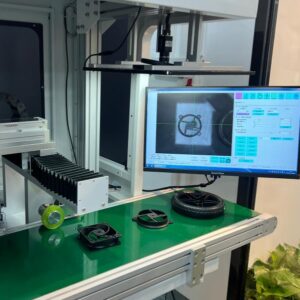
When the workpiece height difference is large, the image varies between sharp and blurry; mostly it is insufficient lens depth of field. The aperture is the primary lever; F8-F11 is the common balance point in industrial Vision; further adjust with working distance, focal length, and magnification, and use the highest point, focus plane, and lowest point three...
Read full article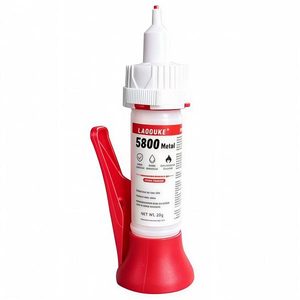
Quick-dry adhesive needle clogging is mostly caused by moisture curing: cyanoacrylate polymerizes upon contact with water, and residual adhesive in the needle thickens and clogs under high humidity and long pauses. Controlling moisture, choosing the right needle material, and doing proper air-source dehumidification and anti-suck-back can significantly reduce clogging.
Read full article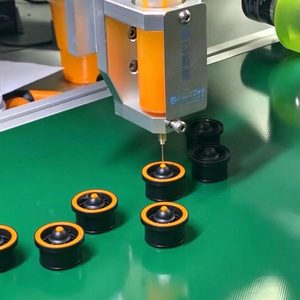
A vision dispensing machine is an automatic dispensing device with Vision positioning; it recognizes the workpiece through a camera, and after the control system compensates for deviations, a motion axis drives the dispensing head to operate — suited to less labor-intensive production for deviated incoming materials or complex workpieces.
Read full article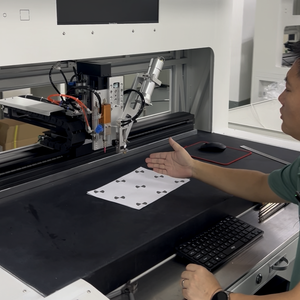
A vision dispensing machine is composed of the Vision system, motion system, dispensing system, control system and auxiliary structure, which are respectively responsible for seeing clearly, positioning, dispensing, scheduling and support, and work together to complete automatic dispensing.
Read full article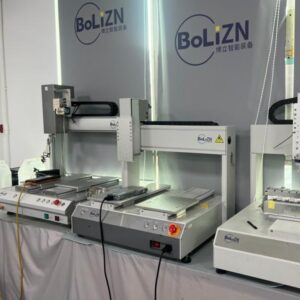
Bolli's desktop vision dispensing machine is divided into two types: single-station (D331) and dual-station (D5331); the core difference is the number of stations. Based on real parameters and the public time-pressure principle, this article compares the working method, footprint, and application scenarios of the two types, explaining...
Read full article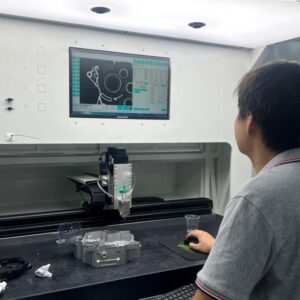
The dispensing process window is the parameter range that keeps products stably qualified. This article explains how pressure, adhesive temperature, speed, etc. constitute the window, and how to respond when the window is too narrow.
Read full article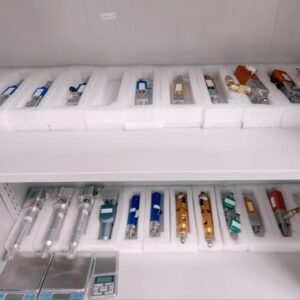
Clearly explain vision dispensing machine dispensing valve body daily maintenance and regular calibration key points, covering seal wear, incomplete suck-back, dispensing-volume drift causes, and the maintenance-calibration differences among three valve types: suck-back valve, screw valve, and jetting valve.
Read full article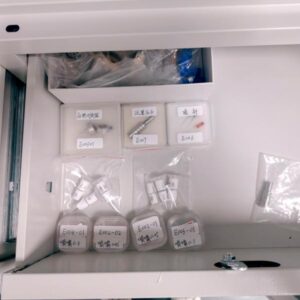
The vision dispensing machine's dispensing quality is largely determined by the dispensing head and nozzle. This article explains nozzle types, bore-to-viscosity dot-diameter matching, and key points of clog handling and daily maintenance.
Read full article