 Bolli Automation specializes in vision dispensing machines_factory direct


Bolli focuses on Vision Fluid
BOLI, FOCUS ON VISION‑BASED FLUID DISPENSING
Search All
BOLI, FOCUS ON VISION‑BASED FLUID DISPENSING
The reason a vision dispensing machine can ”see” the workpiece and accurately place glue is a set ofimage matching and feature recognition process. it first compares the picture taken by the camera with the preset template, finds the position, angle, and key features of the workpiece, then hands the coordinates to the motion system. This article explains how this positioning is completed from imaging and matching to recognition results.
The prerequisite for recognition is a clear shot. Vision dispensing machine throughcoordination of light source, lens, and camera, presenting features such as workpiece contour, hole positions, and edges with sufficient contrast. Wrong light source angle and color make features gray or reflective, and no matter how good the algorithm is later, it is hard to compensate. Bolli's equipment is equipped with Hikvision cameras and self-developed light sources for different workpieces, aiming to make features ”pop” in the image, laying the foundation for matching.
the system first records a standard template; at runtime, it uses grayscale or correlation algorithms to slide and search in the real-time picture, finds the region most similar to the template, thereby locating the workpiece center and rotation angle. This method is stable for regular shapes and fixed features, and can compensate for translation and micro-rotation of workpiece placement. If the matching score is lower thanthe thresholdit is judged as abnormal, to avoid dispensing crooked parts as good products.
when the workpiece has no unified template, or only a few key points need to be captured, feature recognition relies on edges, corners, contours, etc. The algorithm extracts these geometric features and compares them with the preset reference to obtain position and posture. For multi-variety scenarios with changing incoming postures, feature recognition is more flexible than whole-image templates, and can also tolerate partial occlusion and background changes.
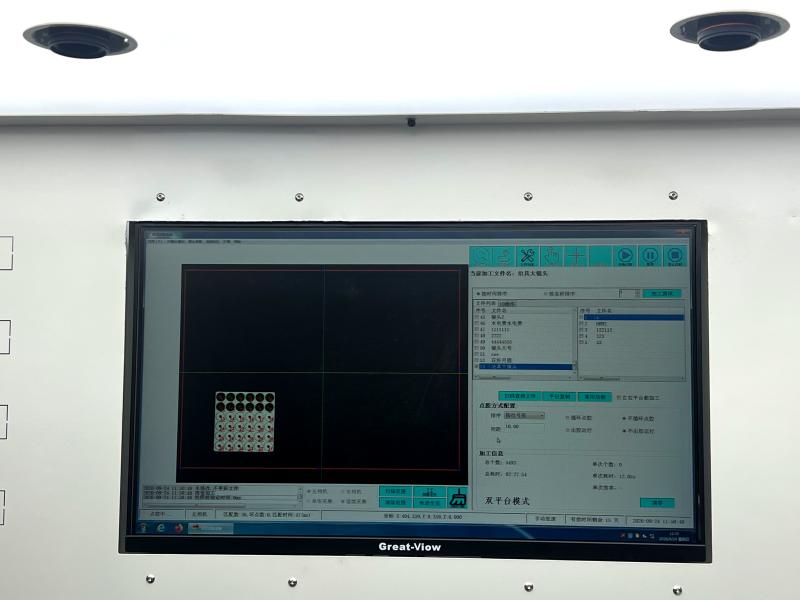
pixel coordinates output by Vision must be calibrated and converted into physical coordinates in the equipment coordinate system, then combined with the alignment reference for offset compensation, before being handed to the motion axis for dispensing. The accuracy of this step depends oncalibration quality and coordinate system unification. if the camera and workpiece are not in the same plane, perspective correction is also needed, otherwise the edge point conversion will be biased.
black or highly reflective workpieces are easily imaged unclearly, needreplace the light source or add polarization; dirty or scratched incoming material interferes with features; when multiple parts are densely arranged, it is easy to mismatch adjacent parts.The approach is to first stabilize imaging, then simplify the matching region and add error-proofing checks. The recognition ability of a vision dispensing machine for features with low contrast is essentially determined byimaging quality and algorithm threshold jointly determine。
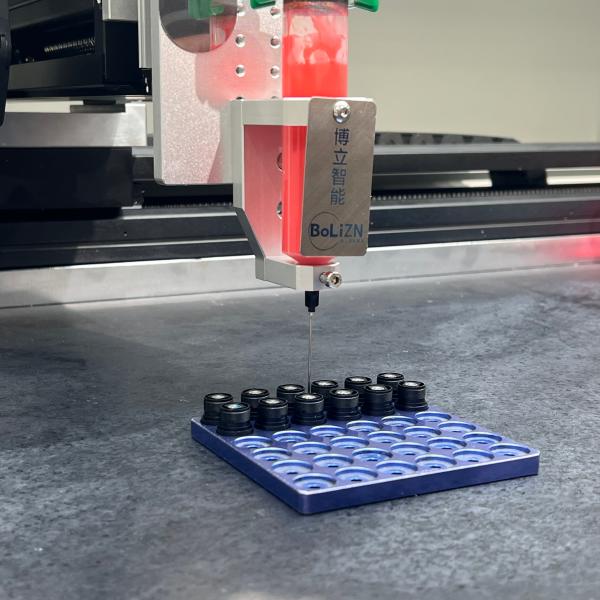
to judge whether recognition is stable, you cannot just look at a single image. Engineering often runs dozens of times under the same workpiece with different placements and different light, and counts the dispersion of positioning coordinates; the smaller the dispersion, the more reliable. If dispersion increases significantly with batches, first suspectlight source agingmagazinelens contamination, rather than the algorithm. Record this kindof repeat-positioning fluctuation value into the acceptance criteria, which is more objective than visually inspecting the image and can also form quantifiable evidence of recognition capability at equipment delivery.
The positioning ability of the vision dispensing machine is built on the chain of imaging, matching and recognition; templates and features each suit scenarios, finally converted by calibration to reliable drop points. If you need confirmation on a specific workpiece Vision schemecamera, light source, and recognition strategy, can be contactedBolli Automation Co., Ltd. 13352947677, with engineering personnel assisting in sample testing and parameter tuning.