 Bolli Automation specializes in vision dispensing machines_factory direct


Bolli focuses on Vision Fluid
BOLI, FOCUS ON VISION‑BASED FLUID DISPENSING
Search All
BOLI, FOCUS ON VISION‑BASED FLUID DISPENSING
In many actual processes, the vision dispensing machine does not just dispense one adhesive to position and finish. Some workpieces need two adhesives combined—for example, epoxy A and B components mixed in proportion and then cured, or main bonding adhesive and edge sealing adhesive applied in sequence. Such needs are hard to complete with a single valve and require a dual-valve or two-liquid valve solution to achieve synchronized or coordinated dispensing. Understanding the process logic of two-component dispensing is the prerequisite for choosing the right equipment and valve body.
Two-component dispensing refers to the process of metering two adhesives (such as A and B components) at a set ratio and then applying them synchronously or sequentially to the workpiece. The main methods to achieve this are two types:
One istwo-component valve (standard two-component valve) completes proportional metering and merging of two adhesives inside the valve body, suitable for systems requiring mixed curing;
the other isDual valveand inline, i.e., two independent valve bodies dispense different adhesives respectively, suitable for scenarios where the main adhesive and sealing adhesive are applied in separate steps.
The vision dispensing machine uses Vision positioning and motion control to make the two adhesive paths precisely coordinate in space and time.
Common cases includeencapsulation and potting of epoxy AB glue, bonding with two-part structural adhesive, and requirescomponents where bonding glue is applied first then sealing glue added. In new energy, automotive electronics, and precision modules, such combined processes are not uncommon. To judge whether to use two-component, the key is whether the adhesive itself consists of two components, or whether a process must apply two functionally different adhesives. If it is a single adhesive, a single-valve solution is simpler and lower cost.
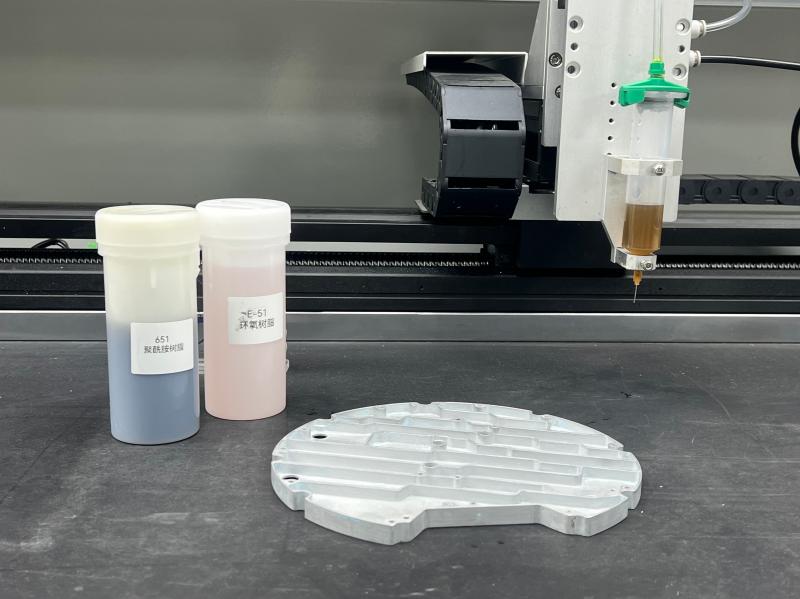
The two-component solution demands more of the equipment than a single valve: it needs two independent adhesive-supply paths, two valve bodies, and motion control that guarantees synchronized action. Bolli's vision dispensing machine can be configured withdual-valve structure, together with Leadshine servo and Xinsheng lead screws providing a stable platform and motion reference, allowing the two adhesive paths to follow under Vision guidancepreset trajectory coordinated operations. The specific machine model and valve body combination must be confirmed by Bolli at the selection stage based on workpiece size, adhesive type, and capacity, to avoid configuration mismatch.
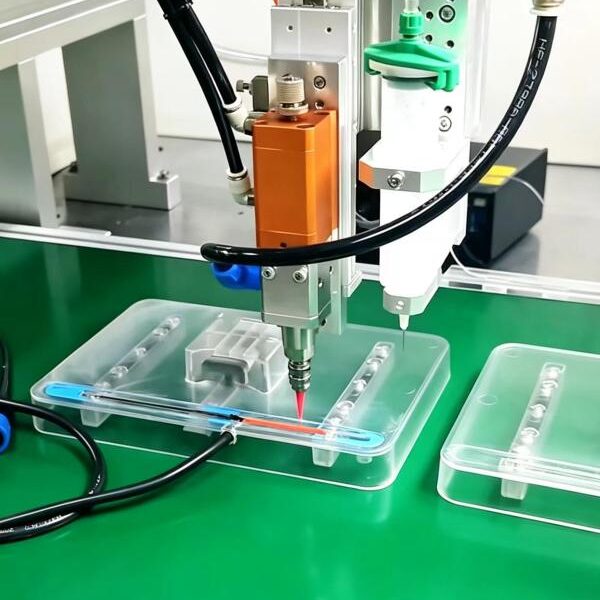
The most critical thing in a two-component system is ratio stability. Ratio deviation brings problems such as uneven mixing, incomplete curing, or insufficient strength. Conventional two-component valves rely on internal metering structures to output by set ratio, so supply pressure, adhesive viscosity consistency, and line state all affect the actual ratio. In production, keep adhesive batch stable and supply pressure steady, and record key parameters for traceability and review, preventing hidden ratio drift from accumulating into batch defects.
dual-valve synchronized dispensing also requires attention tothe spacing between the dispensing head and the two adhesive paths during glue dispensing, and the two adhesives'curing windows of the two glues conflicting. For example, when dispensing A first then B, reasonable operation and positioning time must be allowed;synchronized dispensing must prevent the two adhesive paths from interfering with each other. Bolli's vision dispensing machine supports editing corresponding dispensing programs according to workpiece features, and verifies the glue shape and bonding effect through sample testing at the trial-production stage, locking the process window in advance and reducing mass-production fluctuation.
Before enterprises introduce two-component dispensing, they should first sort outglue types, ratio requirements, workpiece structure, and cycle-time targets. If the existing single-valve equipment already meets the need, there is no need to upgrade blindly; if two-component is truly needed, the supplier should combine sample testing to confirm metering stability and glue-shape consistency before finalizing the equipment. Bolli provides unlimited remote after-sales and sample-testing support, and can assist in evaluating whether a dual-valve configuration is necessary at the solution stage, avoiding over-investment.
In summary, two-component and dual-valve synchronized dispensing apply to processes requiring two adhesives or A/B component coordination; the core lies instable ratio and synchronized control of the two adhesive paths, and not all scenarios require it. Enterprises should sort out the adhesive type, ratio, and cycle before selection, and finalize the equipment only after verifying with sample testing, which ensures yield and avoids over-investment. If you need to evaluate a dual-valve configuration based on specific adhesive and workpiece,You can contact Bolli Automation at 13352947677 for selection and sample-testing advice.