 Bolli Automation specializes in vision dispensing machines_factory direct


Bolli focuses on Vision Fluid
BOLI, FOCUS ON VISION‑BASED FLUID DISPENSING
Search All
BOLI, FOCUS ON VISION‑BASED FLUID DISPENSING
Once the vision dispensing machine has an unplanned stop, it often stalls the whole line. Versus after-repair and periodic maintenance, predictive maintenance continuously collects run data, warns before failure, becoming key to improving overall equipment effectiveness (OEE). Industry experience: one hour unplanned stop may bring production loss far beyond the equipment itself.
Traditional practice mostly repairs only after equipment anomaly, or replaces wear parts on a fixed cycle, easily causing over- or under-maintenance, and stops often catch you off guard.Predictive maintenance watches early signals like dispensing pressure fluctuation, servo load, Vision alignment deviation; when metrics exceed threshold it prompts checking, shifting stop risk forward; maintenance plans can be data-driven scheduled.
Key items worth monitoring include:Dispensing valve glue-output consistency, lead-screw and guide rail smoothness, camera alignment residual, air pressure and temperature-humidity loopenvironment. The vision dispensing machine uses Leadshine servo and Xinsheng lead screw as the motion system; its running state can be continuously recorded, supporting trend analysis and remaining-life judgment. Long-term accumulation also supports process iteration and capacity planning.
Via network connection, the equipment vendor can remotely read run logs, reproduce anomalies and guide on-site handling under authorization, markedly shortening response time. Most process and parameter issues locate online, reducing site trips; remote reproduction also accumulates typical fault samples, feeding the warning model.
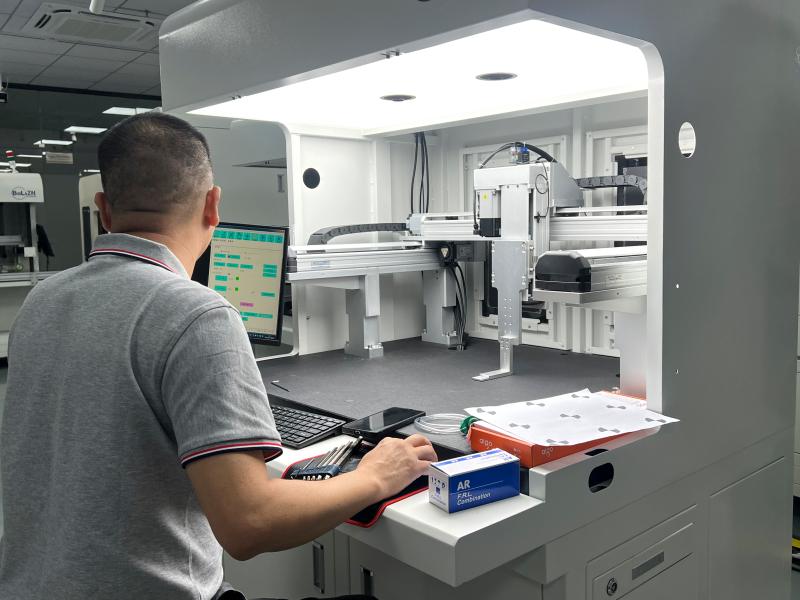
Step one:define key monitoring parameters and early-warning thresholds;
Step two:connect the data link from equipment to the management system;
Step three:establish anomaly-handling and review processes。
Enterprises can start fromDispensing consistency and alignment deviationTwo high-frequency metrics are brought in first, then expanded to full monitoring, controlling initial investment. Set thresholds wide-then-strict to avoid early false alarms eroding trust.
Predictive maintenance does not replace periodic maintenance but complements it: maintenance handles cleaning, lubrication and other basic care; predictive maintenance finds hidden degradation trends. Both share one equipment file, enabling precise maintenance resource allocation and avoiding excessive stops.
Dispensing consistency reflectsValve body and adhesive supply system status; widening deviation often signalsclogging or wear; widening alignment residual suggestsCamera or calibration offset; rising servo load may come fromInsufficient lead-screw lubrication or mechanical interference. Only by reading these signals can early warning be truly useful.
Predictive maintenance moves vision dispensing machine operation and maintenance from“repair after failure” toward ”know before failure”, relying on data monitoring and remote operation-maintenance to reduce unplanned stops. Bolli vision dispensing machine has remote after-sales and training, helping the line run smoothly; to learn about equipment monitoring, contact 13352947677.