 Bolli Automation specializes in vision dispensing machines_factory direct


Bolli focuses on Vision Fluid
BOLI, FOCUS ON VISION‑BASED FLUID DISPENSING
Search All
BOLI, FOCUS ON VISION‑BASED FLUID DISPENSING
Bolli Automation dispensing technology column, continuously updating vision dispensing machine selection, parameter debugging, glue valve matching, takt calculation, defect troubleshooting, etc. practical dry goods, helping electronics manufacturing engineers avoid detours, sharing source-factory frontline experience.
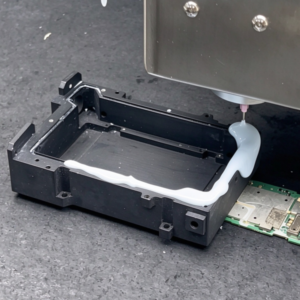
Common vision dispensing machine dispensing defects include offset, intermittent dispensing, overflow, stringing, and uneven bead shape, involving positioning, valve body, parameters, and glue material; troubleshooting should follow a systematic sequence, combined with sampling and records to stabilize yield.
Read full article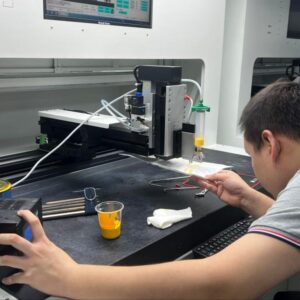
The vision dispensing machine generates waste adhesive and cleaning waste liquid during adhesive change, cleaning, and pipeline flushing; different adhesive types vary greatly in nature and should be managed according to the principles of sealed collection, classified labeling, and compliant handover to qualified units for disposal, avoiding direct discharge and mixed storage.
Read full article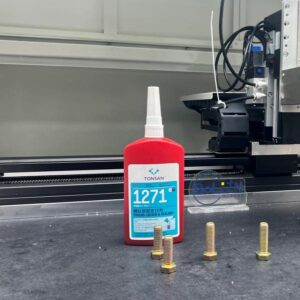
To judge a vision dispensing machine's adhesive compatibility, one must infer the valve-body pipeline from adhesive form, viscosity thixotropy, curing method, and corrosiveness, and verify with unlimited free sample testing. Bolli's multi-valve bodies cover different adhesive properties
Read full article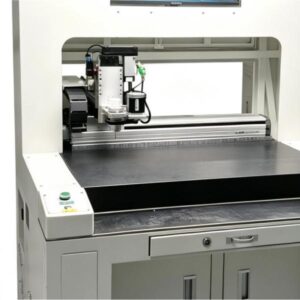
The core of the vision dispensing machine's motion control lies in the coordination of servo and lead screw: the servo determines positioning accuracy, the lead screw converts rotation into linear motion, and Vision and the controller perform closed-loop compensation. Calibration of the whole machine and sampling verification are the final criteria.
Read full article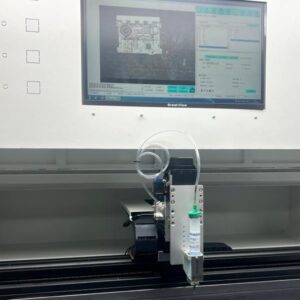
Vision dispensing machine selection looks at three things: granite platform determines precision and stability, inline type determines capacity and takt, desktop machine determines flexibility and small batch; settle the scheme by product batch and precision need.
Read full article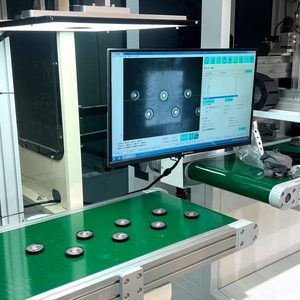
vision dispensing machine capacity is determined by the single-piece takt; the takt is the sum of loading, Vision, motion, and dispensing four segments; travel, camera pixels, valve body type, and trajectory complexity all affect it; to increase speed, optimize the trajectory first then upgrade the configuration; capacity must be measured by sample testing.
Read full article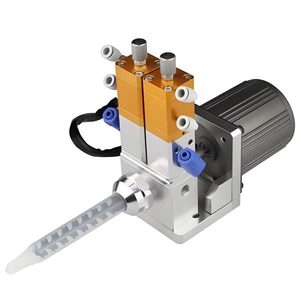
Two-component dispensing on the vision dispensing machine relies on a dual-liquid valve for metering plus a static mixing tube to achieve stable ratio and uniform mixing; the main causes of ratio drift are air pressure, viscosity difference, and temperature drift. For new projects, free sampling is recommended to confirm parameters.
Read full article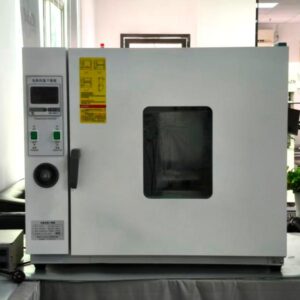
the air source of a vision dispensing machine is a hidden foundation: water and oil cause dispensing drift and valve clogging, requiring dry multi-stage filtration with automatic drainage; pressure fluctuation is smoothed by nearby pressure reduction, stabilizer tanks, and proportional valves; Bolli equipment is designed for 600~1200hpa.
Read full article
The core of matching the vision dispensing machine's adhesive and dispensing valve is: select the valve type by adhesive viscosity, filler ratio, and curing method, then match the feed pressure and needle bore, so as to dispense stably and avoid stringing, dripping, and bubbles.
Read full article
vision dispensing machine multi-variety changeover speeds up through templatization, and relies on glue cleaning and Vision error-proofing; Bolli's multi-program recipes turn changeover into switching.
Read full article