 Bolli Automation specializes in vision dispensing machines_factory direct


Bolli focuses on Vision Fluid
BOLI, FOCUS ON VISION‑BASED FLUID DISPENSING
Search All
BOLI, FOCUS ON VISION‑BASED FLUID DISPENSING
What customers ask most is not ”how much precision”, but"How many can this vision dispensing machine produce in a day". Capacity is not a number pulled out of thin air; it is determined by the single-piece takt:The shorter the cycle time, the higher the output per unit time.. Only by breaking down the cycle time can you know where the bottleneck lies and whether money should be spent on speeding up or adding equipment. Below, using the actual structure of Bolli's vision dispensing machine, we clearly explain the composition of the cycle time and the calculation method.
single-piece takt, etc. inthe loading positioning, Vision acquisition, motion movement, and dispensing glue-application — the four segments' (if it also includes in-line curing, addcuring, etc. to be). After loading, Bolli's vision dispensing machine completes feature collection and positioning with the Hikvision camera, Leadshine servo drives the screw to move along the planned trajectory, XY speed can reach 800 mm per second, and finally the valve body completes the dispensing. Each segment can become a bottleneck: the higher the Vision camera pixels and the more stable the acquisition, but high pixels take slightly longer to acquire than 5 million pixels; the larger the travel, the longer the movement time.
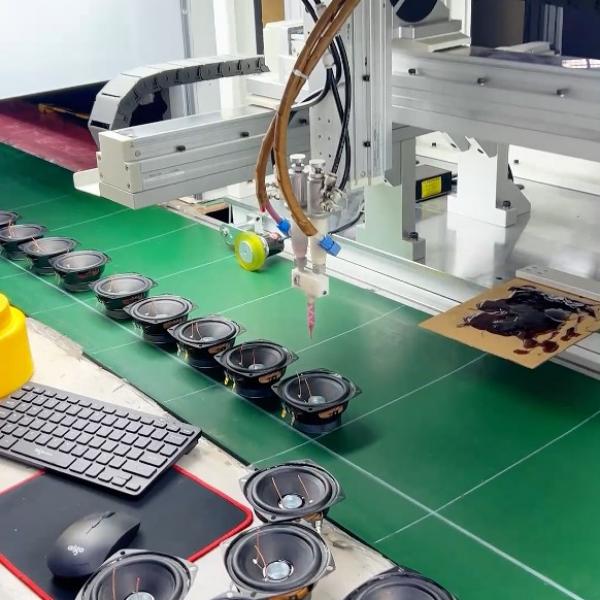
The first is travel (stroke): Bolli BL-SS331 has a travel of 300 by 300 mm with short movement; BL-QB931 has a travel of 900 by 300 mm, and long-travel parts have significantly more movement time.
Second is the camera configuration: 500w, 1200w, 2000w pixels correspond to different acquisition and processing rhythms.
Third is the valve body type: pneumatic jetting valve and piezoelectric valve belong to non-contact high-speed dispensing, with a rhythm faster than contact needle valve; Screw valve is more stable in takt under strict metering but not necessarily the fastest.
The fourth is trajectory complexity, arcs and filling take more time than single points.
Bolli follow-type solutions have a repeat positioning accuracy of about ±0.3mm; granite platform solutions can reach ±0.05mm. Which type to choose depends on how to balance precision and speed.
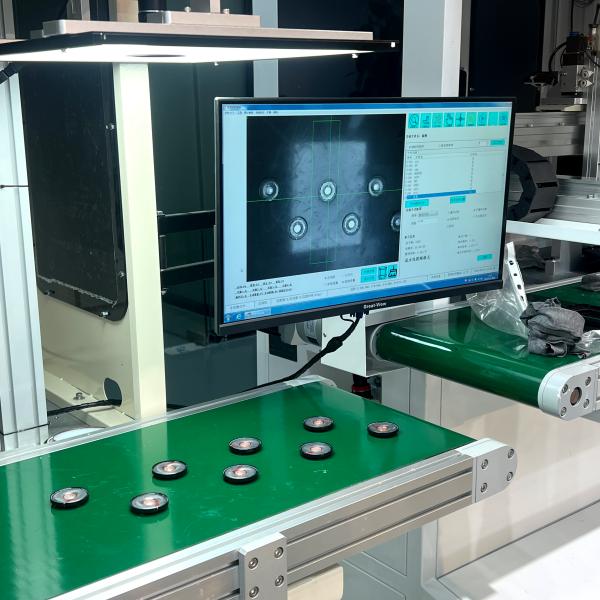
to increase speed, optimize the trajectory first: combine nearby points, reduce empty travel, optimize the dispensing entry order — often faster than changing equipment. For valve bodies, non-contact jetting valve suits high-speed continuous gluing; multi-station or machine models with R axis overlap loading/unloading and gluing to reduce waiting; the in-line panoramic solution lets Vision position continuously without stopping, further pressing pauses. When Bolli engineers do sample testing, they measure the takt, give the single-piece time and bottleneck segment, helping users judge whether to optimize the program or upgrade the machine model.
taking a product with a comprehensive single-piece takt of about eight seconds as an example, the theoretical output is about 450 pieces per hour; after deducting loading/unloading and yield, the effective capacity is based on sample-test measurement. Note this number is an example, not a commitment for a certain machine model — different workpieces, adhesives, and trajectories vary greatly. The safest approach is to bring real samples to Bolli for free sample testing, obtain the measured takt, then calculate capacity and the number of devices required, avoiding production-line bottlenecks caused by experience-based misestimation.
vision dispensing machine capacity is determined by the single-piece takt; the takt is the sum of loading, Vision, motion, and dispensing four segments, and the bottleneck may be in any link; to increase speed, optimize the trajectory first, then look at valve body and station configuration. Accurate capacity must be calculated by Bolli's free sample-test measured takt. For capacity evaluation and sample machine testing, please contact Bolli: 13352947677.