 Bolli Automation specializes in vision dispensing machines_factory direct


Bolli focuses on Vision Fluid
BOLI, FOCUS ON VISION‑BASED FLUID DISPENSING
Search All
BOLI, FOCUS ON VISION‑BASED FLUID DISPENSING
Whether the vision dispensing machine's ”hand” is stable depends on the motion control. Many purchasers get dizzy from the pile of metrics in the spec sheet; in fact the core is just two parts:the servo drive responsible for generating force,and the lead-screw transmission responsible for converting rotation into linear motion. When the two coordinate well, dots go accurately and stop steadily. Understanding how they coordinate is more useful than obsessing over single parameters. Below, clearly explain Bolli vision dispensing machine motion-control logic.
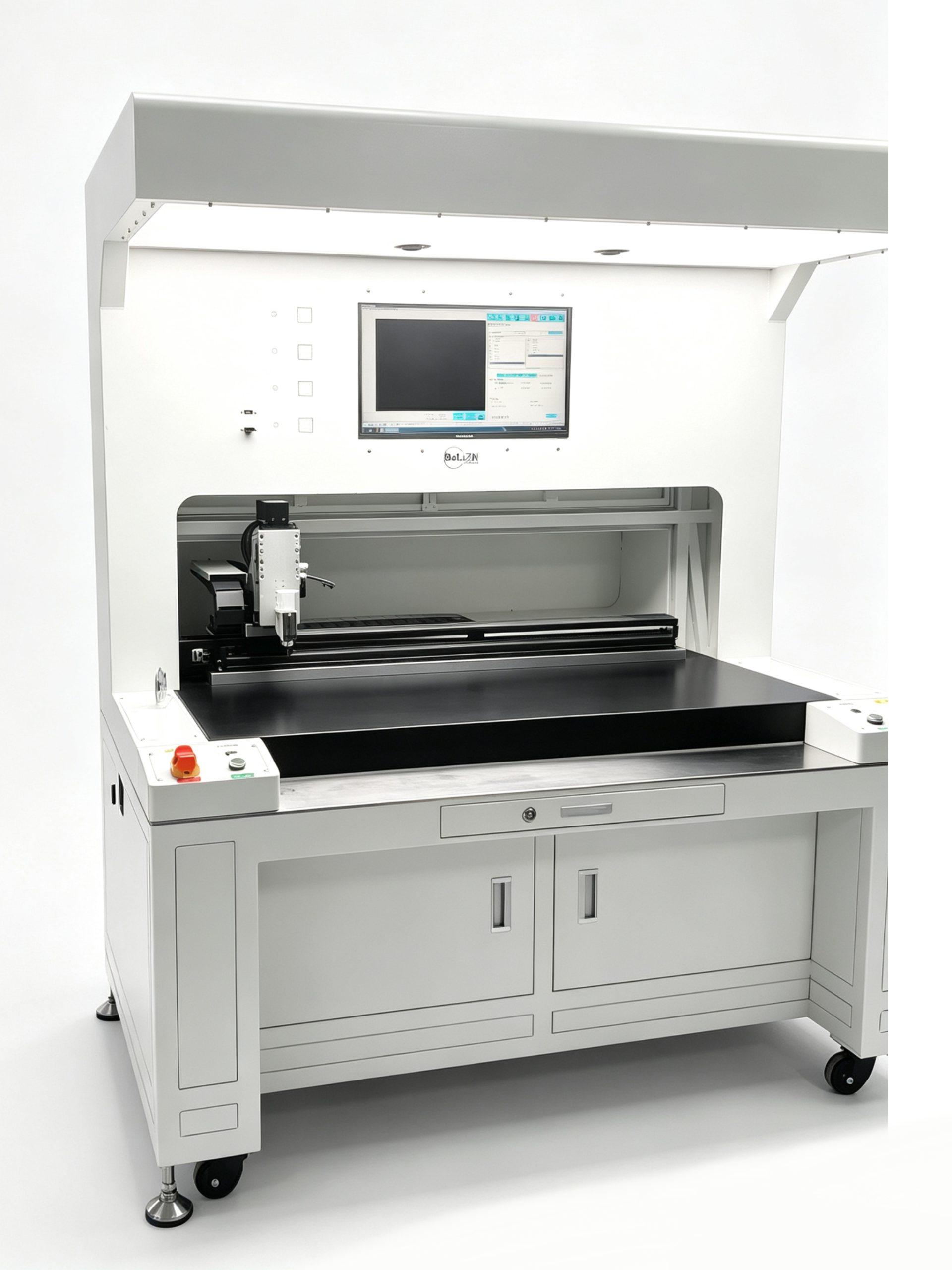
Bolli vision dispensing machine uses Leadshine servo drive, the motion controller issues commands, the servo motor turns and stops precisely by trajectory. Industry servo systems have different resolution grades; whole-machine precision is ultimately the manufacturer's calibration result, not a single indicator. Bolli full-series nominal XY speed about 800mm/s, Z about 500mm/s, meeting most dispensing takt. Post-arrival micro-compensation pulls cumulative error back a tier, another reason whole-machine precision often exceeds single-part indicators.
The servo turns revolutions; what actually drives the dispensing head to move is the lead screw. Bolli vision dispensing machine uses Xinsheng lead screw with linear guide. Ball screws have industry grades C0 to C10 etc.; higher grade is more precise; specific selection by whole-machine structure and scenario. The rigidity of screw-plus-guide directly affects jitter at high-speed start/stop.
A single servo or single lead screw is not enough. Bolli's approach: Vision shoots the workpiece position accurately, the controller plans the trajectory, the servo drives the lead screw to the target point by command, then does micro-compensation after arrival. For granite-base machines, the structure is steadier with less thermal deformation, pushing precision higher-e.g. the granite panoramic scheme about ±0.05mm.
No matter how good the servo and lead screw, long running drifts from wear and thermal drift. Bolli suggests standard Vision calibration and needle alignment, pulling motion error back periodically. Making calibration a fixed rhythm keeps motion stability long-term. This is why Bolli suggests periodic recalibration.
Buying a vision dispensing machine need not obsess over single-part paper grade; look more at whole-machine calibrated repeatability vs your glue-path need. Bolli provides unlimited free sample testing, letting you see motion stability on the real workpiece-more convincing than the parameter table. If needed, ask the manufacturer for a same-structure machine calibration report as reference.
The motion control of the vision dispensing machine centers on the Leadshine servo drive and Xinsheng lead-screw coordination:The servo governs ”how accurately it moves”, the lead screw governs ”where it goes”, then Vision and the controller do closed-loop compensation. Bolli vision dispensing machine is judged by whole-machine calibration, providing unlimited free sample testing to verify stability firsthand. If the motion scheme is uncertain, contact 13352947677.