 Bolli Automation specializes in vision dispensing machines_factory direct


Bolli focuses on Vision Fluid
BOLI, FOCUS ON VISION‑BASED FLUID DISPENSING
Search All
BOLI, FOCUS ON VISION‑BASED FLUID DISPENSING
plastic parts fail to bond firmly in dispensing; don't rush to change the adhesive—often it is insufficient surface energy.PP, PE, silicone and other low surface energy materials—the adhesive droplet won't spread, edges lift and the center is hollow. Plasma isdry activation:remove oil film, graft polar groups, micro-roughendone in one step, replacing sanding and primer, without changing the adhesive formula.
Plasma only affects the surface few nanometers, invisible to the naked eye. The vision dispensing machine's camera cannot see this layer difference; judgment relies on water: a deionized water droplet on untreated PP can reach a contact angle above 90°, and after activation it drops below half. Adhesive bonding generally requires above 40–42 mN/m; untreated PP and PE are only around 30 mN/m—a big gap.Plasma uses ions, electrons and UV photons to graft hydroxyl and carboxyl groups into the chains, only when surface energy is raised can the adhesive wet it out.
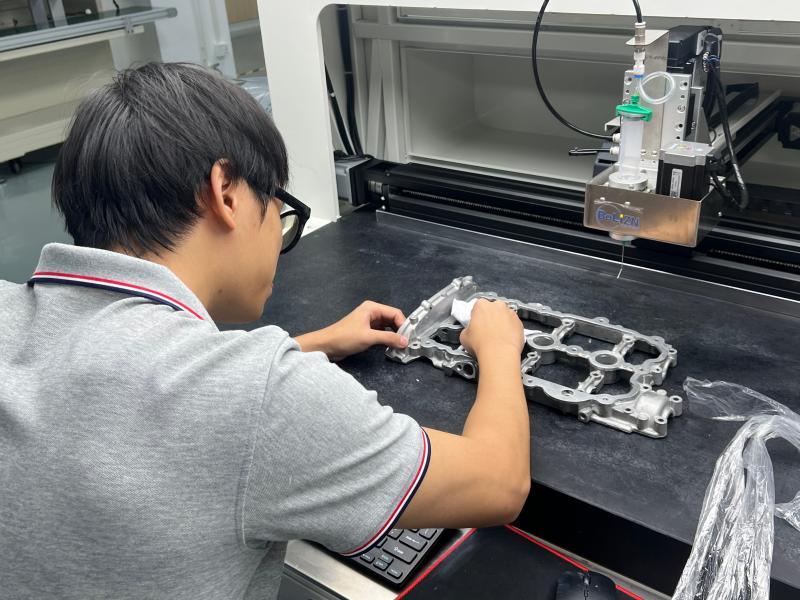
Use dyne pen for quick screening on the production line,38、42、52mN/mDraw a line; no shrinkage within 2–3 seconds counts as pass; general adhesive bonding passes40–42mN/m. Batch spot-check using water contact angle is more rigorous; Bolli Automation performs both during sample testing, and the report is delivered with the workpiece. The dyne pen liquid itself contaminates the interface, so do not use the tested position for dispensing.
plastic activation decays. Polyolefins like PP show obvious re-decay within hours to a day; PC, PET, ABS can last one to several weeks, depending onmaterial, additive and storage method. Sotreat-and-dispense, transfer to the next process within 4–8 hours; do not stack in transit;humidity above 80% RH decays faster, the gas source is clean, oil-free and water-free.power and time must also be controlled— over-treatment burns out a weak boundary layer, and prolonged scanning of ABS also turns it white.
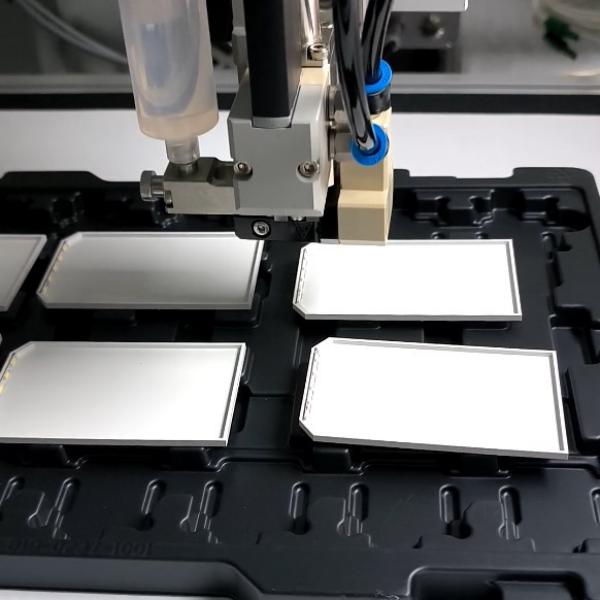
For plastic part production lines like this video, plasma is mounted at the pre-dispensing station; after treatment it flows directly, right within the time window. The camera recognition and trajectory of Vision automatic dispensing equipment are not affected; Bolli configures the treatment section according to the line tact time, and both production line and single machine loading/unloading can be configured.
Plasma does not replace adhesive selection; whether the adhesive matches the substrate,written in the adhesive compatibility article before; the time window from treatment to dispensing and power parameters are recommended to be managed together with process records,the approach from the article on how to set process parametersdirectly applicable. If unsure about the difference before and after treatment, send the workpiece for sample testing for comparison. For selection, sample testing and after-sales, contactBolli Automation Co., Ltd.13352947677。
Plastic part sample photos: parts after plasma treatment should be transferred to the dispensing station as soon as possible
Source statement: plasma action mechanism, dyne value criteria and time-decay, referencing Yancheng Industrial's 'Plasma Treatment Equipment for Plastic Part Painting and Bonding Process' (yjplasma.com, 2026), S. Sabreen's 'How Long Does Plasma Surface Treatment Last?' (sabreen.com), Luodanni's 'Vacuum Plasma Cleaning Machine Parameter Adjustment Q&A' (kodeny.com), retrieved November 2026.