 Bolli Automation specializes in vision dispensing machines_factory direct


Bolli focuses on Vision Fluid
BOLI, FOCUS ON VISION‑BASED FLUID DISPENSING
Search All
BOLI, FOCUS ON VISION‑BASED FLUID DISPENSING
When the workpiece height difference is large, the image is sharp on top and blurry below; the on-site first reaction is often that the camera is broken or the lens is bad, but mostly it is insufficient depth of field. First stop down the aperture and boost the lighting - eight times out of ten it recovers; only if that fails do you touch the working distance or change the lens.
Depth of field is the range before and after the working distance where sharp focus can be maintained.. Flat workpieces such as PCB are little affected; height-difference workpieces like stepped housings and inserted component pins - depth of field directly determinesCan the whole image be captured clearly in one shot?. When depth of field is insufficient, the feature edges at high and low points become soft, sub-pixel positioning drifts, and the vision dispensing machine's positioning stability drops.
The F-number is the factor that most affects depth of field.: F2.8 is shallow, F8 is mid, F16 is deep; industrial Vision commonly uses F8-F11 as the balance point. By the industry estimation formula, with other conditions unchanged, stopping the aperture from F4 to F8 roughly doubles the depth of field.The trade-off is reduced light intake.- light intake drops to a quarter; each step the aperture closes, illuminance roughly doubles, so the light must keep up, or noise and ghosting eat the clarity back. Don't screw the aperture all the way down either; too small causes diffraction blur, which hurts detail instead.
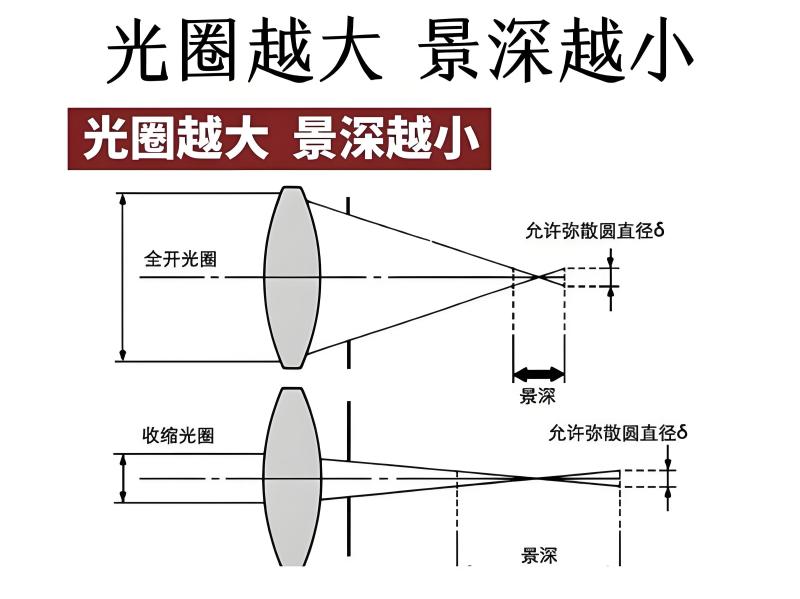
Increasing the working distance, switching to a short-focal-length lens, or reducing magnification can all increase depth of field.; when the lens is close to the workpiece, depth of field drops sharply. A telecentric lens stabilizes magnification but does not automatically solve depth of field - you still must stop down the aperture. How to pair focal length and field of view,that camera lens selection articleIt breaks it down further; the two articles can be read together.
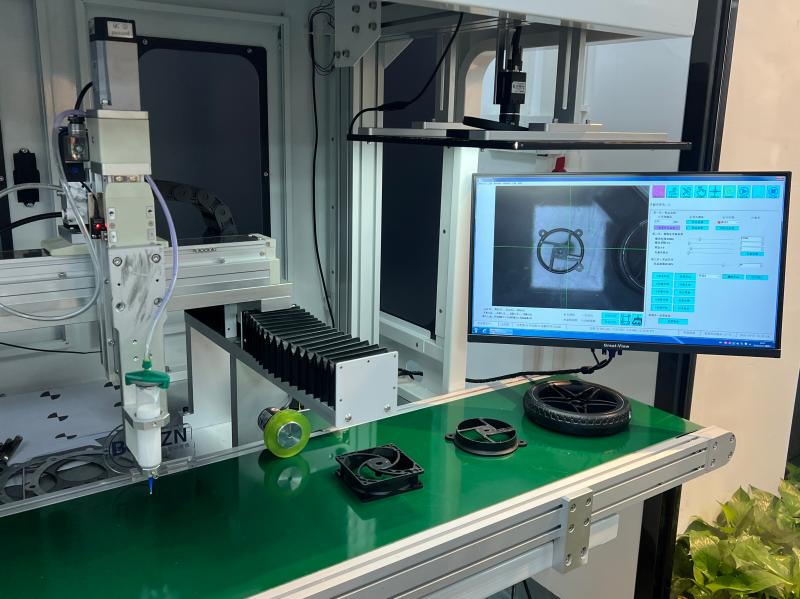
After tuning, take one shot each of the highest point, the focus plane, and the lowest point; judge by the smallest feature that must be recognized; all three must be stable to count.Record every change of aperture, exposure, gain, and light-source brightness in the parameter table., Bolli does the same documentation before shipment, so next time you reproduce or switch models you won't start from scratch. The specific tuning method for exposure and focus,camera exposure and focus articleThere are steps.
Depth of field tunes the balance between clear range and brightness: first the aperture, then the working distance; only if neither works do you change the lens - step by step. Such height-difference conditions are common on Vision automatic dispensing equipment; Bolli vision dispensing machines are equipped with Hikvision cameras and self-developed light sources; for sample testing, commissioning, and after-sales you can contactBolli Automation Co., Ltd.13352947677, configured on-site according to the workpiece height difference.

Source statement: VSK "DOF Depth of Field Range" (vsk.com.tw); Yaotu Network "Industrial Camera Lens Selection: A Complete Breakdown from Parameters to Practice"; Ayi Network "Focal Length, Aperture, Depth of Field - How Industrial Imaging Systems Select Optical Imaging Lenses?". Conclusions on F-number ranges, depth-of-field doubling, and illuminance doubling etc. come from the above industry references; Bolli's related content is limited to equipment configuration and after-sales explanation.