 Bolli Automation specializes in vision dispensing machines_factory direct


Bolli focuses on Vision Fluid
BOLI, FOCUS ON VISION‑BASED FLUID DISPENSING
Search All
BOLI, FOCUS ON VISION‑BASED FLUID DISPENSING
when a vision dispensing machine runs sealing lines and drawn lines, the drawing often specifies the dispensing width. It is common for the same program to produce some wide and some thin sections, or for the whole line to be wider than the drawing, and many people adjust the air pressure first and only make it worse. The width is determined by several variables together, so understand the relationship first.
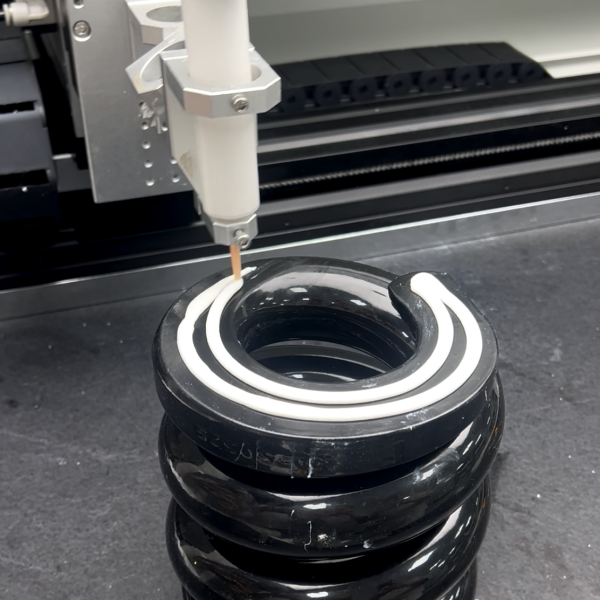
the most fundamental determining factor of the dispensing width isneedle inner diameter, industry experience puts the width at about1.5 times the inner diameter, it varies with the adhesive and substrate, chooseselect the needle at about half the target dispensing width, fine-tune by actual measurement on a test piece. Once the needle is fixed, what can be changed isthe three variables of pressure, speed and standoff height; using a small needle with higher air pressure to make a wide line produces glue accumulation, not a wide line.
a whole line being too wide is usually due to excessive pressure or a slow travel speed, the dispensing spreads longer;in cold weather the viscosity of high-viscosity adhesive increases, the same pressure gives more dispensing.a corner being noticeably wider than a straight line means the turn was not slowed down, reduced to one half to seventy percent of the linear speed.
if too thin or intermittent, besides low pressure and high speed, check two more places:partially clogged needle, the dispensing becomes thin with stringing;the pipeline is too long with many bends and a large pressure drop, the actual pressure at the needle is lower than the gauge reading. The lower the adhesive level in the pressure tank, the more the width drifts; thick at the start and thin at the end is mostly due to this.
the needle-tip-to-workpiece height is generally one to one and a half times the inner diameter. If it is too high, the line landing point drifts and the width fluctuates; if too low, it scrapes the workpiece and smears the line. For workpieces with height differences, follow the height change and first see whether support can be added to level it.
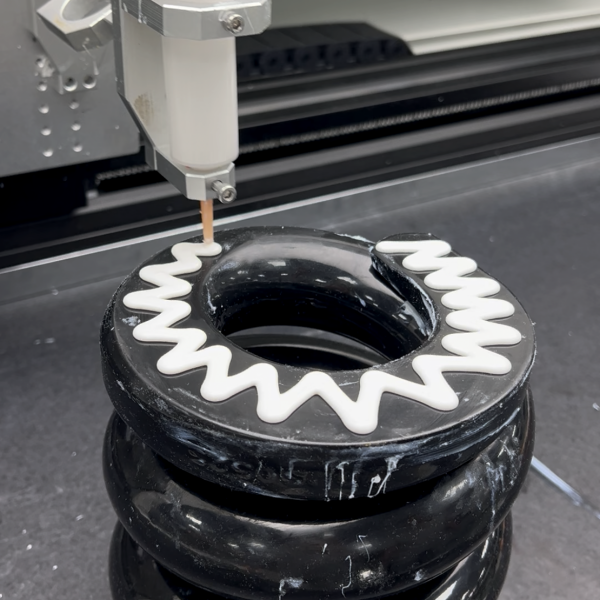
on Vision automatic dispensing equipment these variables are all written into the program,change one at a time. First set a conservative travel speed, then approach the target width with pressure, and finally fine-tune the speed; reversing the order makes misjudgment easy, because changing the speed lengthens and thins the line, which looks like insufficient dispensing, and adding pressure overshoots. After tuning, dispense several sections on a test piece and measure the width with an image measuring instrument; it is stable only when the average falls within plus or minus ten percent of the target. The dispensing height is about three to six tenths of the width, varying with the adhesive. Run continuously for half an hour before batch production, and if fluctuation is large go back and check the adhesive supply. For sealing-line jobs the width and dot pitch are set together,covered in the article on how to determine the dot pitch; the overall coordination of parameters,covered in the article on how to set process parameters。
if the dispensing line width cannot be stabilized no matter how you adjust it, record a complete travel video and send it, or call 13352947677 to reachBolli Automation Co., Ltd. after-sales, watching the coordination of the three variables on video is faster than describing it over the phone.
Source statement: needle inner diameter matched to dispensing width and height at one to one and a half times the inner diameter refer to Huale Sealing (walleseals.com); dispensing width at about 1.5 times the inner diameter, dispensing height at three to six tenths of the width, and setting the speed before adjusting pressure refer to a Baidu AiCaigou article on dispensing width control (b2bwiki.baidu.com); corner deceleration and level drift refer to Bobet Automation (dgbobet.com), retrieved in November 2026. These are industry experience values, subject to manufacturer recommendations and actual measurements; Bolli equipment configurations are subject to the official specification sheet.