 Bolli Automation specializes in vision dispensing machines_factory direct


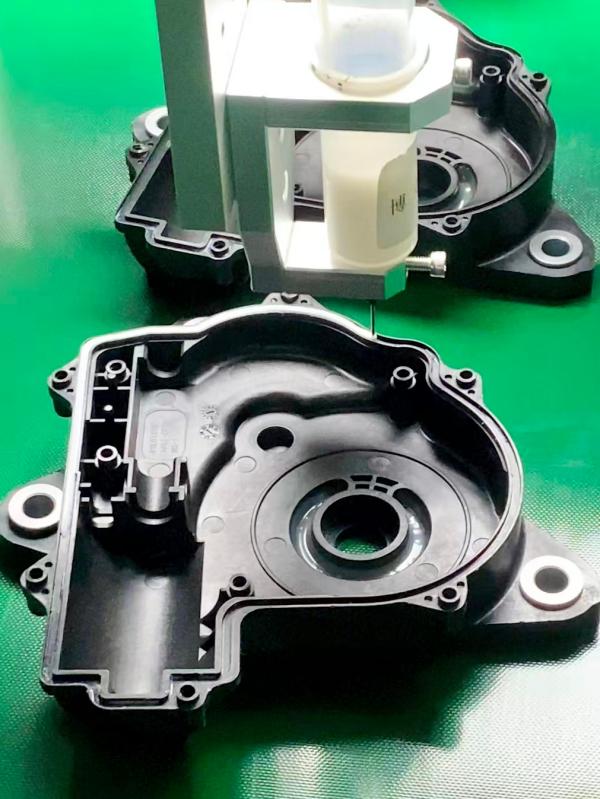
black and reflective products with inaccurate vision dispensing positioning?
people doing vision dispensing often encounter two types of headache products: black plastic shells come out all dead black, and positioning features are simply not found; metal and glass surfaces become overexposed and white as soon as light hits, the image a blur of white. Both types of problems occur at the same step — imaging, not dispensing itself. With the right lighting scheme, most positioning problems of black and anti-reflection products can be solved.
I. Why black and anti-reflection products are hard to photograph
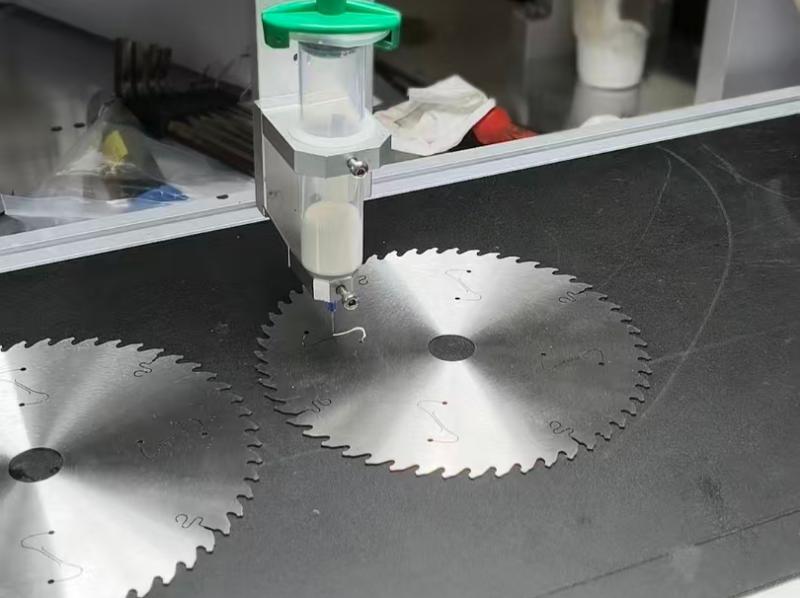
the difficulty with black products lies in absorbing light. The black surface absorbs most of the incident light, the camera receives very little reflected light, the image is overall dark, the grayscale contrast between feature points and background is low, and the algorithm finds it hard to extract contours. Anti-reflection products are the opposite: metal, glass, etc. mirror or high-gloss surfaces concentrate light reflection into the lens, local pixels are overexposed, and the image shows bright spots and ghosting.
II. Four lighting methods for anti-reflection problems
for anti-reflection, the industry has four mature approaches.
First, use a low-angle light.the light source illuminates at a low angle close to the surface; the reflected light does not enter the cameras directly; it is recommended to keep the light line parallel to the measured surface, which also highlights surface concavity and convexity details.
Second, diffuse shadowless light source. The light, after diffuse reflection, illuminates evenly from multiple angles, compensating for changes in the object's surface angle, making the image more uniform.
Third, coaxial light illuminationThe light source illuminates coaxially via a beam splitter aligned with the camera's optical axis; the reflected light and the lens share the same axis line, effectively eliminating image ghosting, and is especially suited to mirror-smooth surfaces.
Fourth, polarizer combinations. Install polarizers in front of the lens and light source and adjust the angles to filter out the reflected light from the smooth surface. Orthogonal polarizer combinations can block most specular reflected light, significantly suppressing glare and overexposure.
3. Enhancing Imaging of Black Products
the approach for black products is to supplement light and expand the dynamic range. Two proven practices:
First, the dome light source, the light, after reflecting from multiple directions of the hemispherical inner wall, illuminates the measured surface evenly, especially suitable for curved-surface and complex-shaped bright black parts;
two is HDR high-dynamic-range imaging, in the same scenario, quickly capture multiple images with different exposure times and then fuse them, which both preserves highlight details and presents dark-area gradations; it is very effective for surfaces containing extremely bright and extremely dark regions at the same time.
In addition,multi-angle strip light source combinationalso helps — low-angle light is sensitive to protrusions and scratch edges, high-angle light easily reveals concavities; combined use highlights feature contours.
IV. Coordination between algorithm and equipment levels
Beyond imaging there are two more layers of assurance:
at the algorithm level, image filtering, contrast stretching and edge sharpeningetc. preprocessing manual segment can enhance dark-area details and improve the stability of feature extraction.
at the equipment level, the matching of light source and camera is important — the light-source wavelength, size, and uniformity need matching optimization targeting the camera's response characteristics. Bolli adopts a combination of self-developed light source and Hikvision industrial camera in the BL series; the camera provides multiple pixel options from 1.3 million to 20 million according to the machine model; in shooting scenarios of high anti-reflection metal surfaces and transparent workpieces, the self-developed light source outperforms general solutions, providing a stable imaging foundation for Vision positioning.
5. Summary
black products are hard to shoot because light absorption causes low contrast, and anti-reflection products are hard to shoot because specular reflection causes overexposure. Anti-reflection is handled by four methods: low-angle lighting, diffuse shadowless light source, coaxial light, and polarizer combination; black products use dome light source and HDR multi-exposure light fusion to enhance imaging, combined with algorithm preprocessing and light-source camera matching, so the vast majority of black and anti-reflection products can achieve stable positioning.