 Bolli Automation specializes in vision dispensing machines_factory direct


How does a vision dispensing machine connect to the production line?
in scaled mass production, a dispensing machine rarely operates alone; it usually needs to loading, unloading, curing, and inspection equipment form a complete production line. Whether it can connect to the line directly decides whole-line takt and consistency. The dispensing machine must seamlessly connect with upstream/downstream to form an automated line, reducing manual intervention. This article explains the mainstream methods of line integration once, helping you build overall understanding.
Automated loading and unloading systems generally include four parts:
1. Loading mechanism
1. Loading Mechanismuse vibratory bowls, tape feeders, or gantry robots to send workpieces to be dispensed into fixtures;
2. Unloading Mechanism3. Material buffer uses belt line
ormagazineto coordinate the rhythm of front and back processes, avoiding line stoppage due to speed mismatch;4. Handling robot
4. Handling RobotResponsible for transferring workpieces between equipment.
This system integrates seamlessly with the dispensing machine control system; efficiency over manual loading/unloading improves markedly, also reducing contamination and damage from manual contact.
II. In-Line Integration: Workpieces Move with the Line, No Machine Stoppage
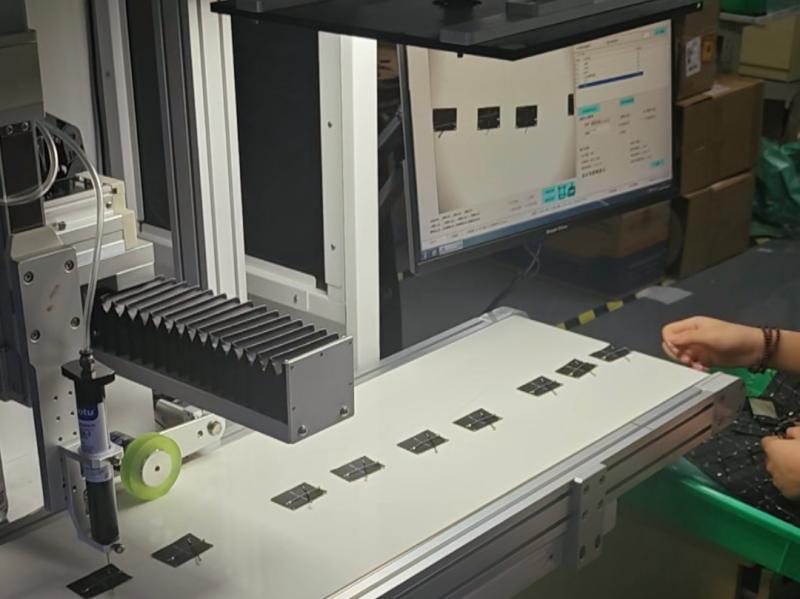
Inline fully-automatic dispensing machine can directly connect to belt conveyor, double-speed chain, roller line or mechanical manual loading/unloading mechanism; workpieces flow into the processing zone at constant line speed, no stop for loading/unloading, achieving uninterrupted continuous coating. To handle placement offset during conveying, the Vision-follow system shoots the workpiece contour in real time, dynamically correcting the dispensing path, ensuring uniform glue path across the line. Such equipment moves fast, matches high-takt mass production, the mainstream choice for large-batch factories.
III. Communication and coordination: the dialogue with the production line
for a dispensing machine to integrate into the production line, communication is indispensable. It usually connects with line PLC or MES via Modbus, EtherNet/IP and other standard industrial protocols, auto-recognizing workpiece presence, syncing dispensing start/stop, and uploading dispensing speed, glue volume, production takt and other data for quality traceability and process optimization. Industry vendors summarize integration into five steps:requirements analysis, equipment selection, electrical and communication connections, mechanical installation and debugging, software and control system integration, among which communication protocol matching is the key to successful linkage.
IV. Bolli solution and landing suggestions
Bolli BL series uses I7 industrial PC with Hikvision camera; after Vision alignment guides the glue path, can connect to the inline line; dispensing is air-pressure driven plus non-contact, fitting most general adhesives. Suggest before connecting confirm equipment levelness, communication-protocol match, fixture and conveyor-takt coordination; best bring actual workpiece for on-machine trial, verify whole-line linkage. Bolli provides unlimited remote after-sales, can guide communication and takt matching online during debugging.
V. A Reminder for Planning
Connecting to the production line is not just placing the equipment beside the line; you need tocalculate the takt time clearly, reserve maintenance space, and define abnormal stop logic. Small and medium batches can first use semi-automatic plus manual loading/unloading as a transition; when volume grows, move to fully automatic in-line. Either way, validating on a small line before expanding to the whole line is safest; Bolli also recommends complex lines see a sample first before deciding the plan.