 Bolli Automation specializes in vision dispensing machines_factory direct


Where is the dispensing machine used in new energy vehicles?
— battery, motor, electronic control-battery, motor, electronic control, is the power and brain of the whole vehicle. Compared with fuel vehicles, the three-electric system forSealing, thermal conductivity and electrical insulationdemands far exceed, and dispensing is the key process meeting these demands. From cell fixing, battery-pack waterproofing, to motor-winding potting, electronic-control module protection, almost every core part needs glue. Bolli vision dispensing machine with Hikvision camera can undertake three-electric line Vision positioning and trajectory programming; if process unsure, free sample.
The battery pack is where dispensing is most intensive.
The battery pack is where dispensing is most intensive.Between cell and water-cooling board coat thermal glue to conduct heat out; between modules fill thermal-insulation glue; housing seams and harness pass-throughs seal with waterproof glue. Industry data: drive-motor silicone withstands -60℃ to 200℃, waterproof up to IP68, matching battery-pack condensation-shortcut puzzle. On the line, two-component thermal glue at 1:1, automatic dispensing machine quantitative coating, layer 0.5-1mm, then bond and cure, forming a dense thermal layer.
II. Drive motor: stator potting and housing sealing
The motor runs hot in operation; the winding needs potting glue to eliminate local hotspots and improve insulation. Industry practice is vacuum-pot silicone potting compound for the winding, preheat to reduce viscosity, degas then slowly pour and step-cure; meanwhile motor housing seams, end caps and magnet fixing also use adhesive bonding seal, resisting oil and dust, extending life. Related research notes adhesive replacing bolt connection can cut battery-pack connection structure weight 15%-20%, clear lightweight gain.
Electronic control is the control brain of the whole vehicle
, power devices concentrate heat, needing thermal conductive potting to quickly export heat;control boardControl boardAlso do three-proof coating against moisture and dust. Under 800V high-voltage platform, the insulation stability of the glue layer directly relates to safety. Industry references list electronic-control module encapsulation as a dispensing focus, covering motor controller, battery-management system etc.; the adhesive must meet heat dissipation and insulation simultaneously.
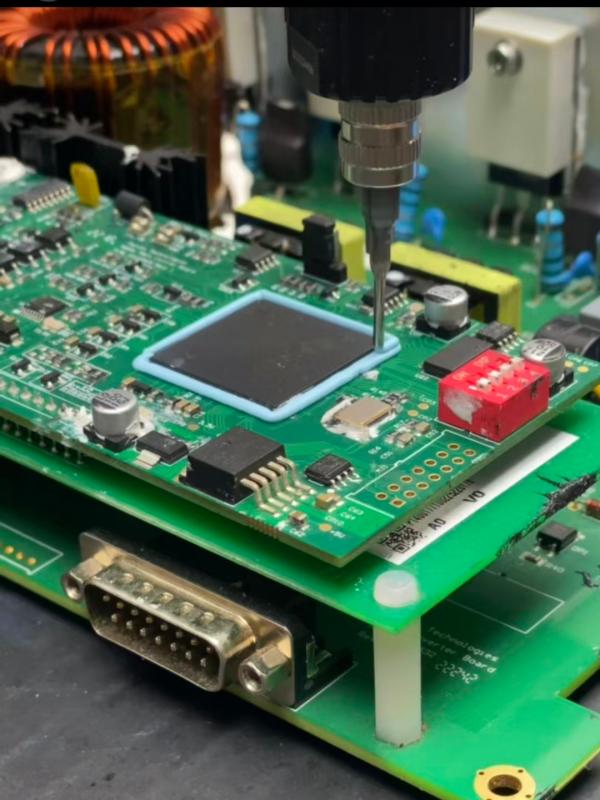
IV. Requirements for the dispensing equipment and Bolli's solution
Three-electric dispensing is generally multi-adhesive multi-process mixed line-same equipment may need structural bonding of thermal glue, continuous coating of sealant, and compatible potting. This demands accurate Vision positioning, stable feed, quick valve change. Bolli BL series uses I7 industrial PC with Hikvision camera; after Vision positioning guides the glue path; dispensing is air-pressure driven plus non-contact, high-viscosity precision potting can optionally use screw-valve module.
For high-precision scenarios, Bolli selects the granite Local vision dispensing machine, precision up to ±0.02mm, a reference baseline for high-precision selection. For complex three-electric parts, free sample first, confirm glue path and parameters with real-machine data.
V. A reminder on model selection
Three-electric dispensing is not just buying a dispensing machine; adhesive properties, curing conditions and cleanliness all affect the final protection level. Before purchase, better to bring actual samples to test on the machine;Confirm glue-path coverage, consistent glue volume and curing effect, then decide equipment config. Bolli provides unlimited remote after-sales; process debugging and coordinate calibration can be guided online, reducing risk from small batch to mass production.