 Bolli Automation specializes in vision dispensing machines_factory direct


What should be noted when dispensing curved and inclined surfaces?
For ordinary flat-surface dispensing, a three-axis machine with a vertically moving needle can spread the adhesive evenly. But once the product is a curved surface, inclined surface, or has deep cavities, the surface normal direction keeps changing. The difficulty of curved-surface dispensing is not 'reaching the position' but 'always fitting the surface at the correct angle", which is why planar equipment directly dispensing curved surfaces easily fails.
I. Why curved-surface dispensing is harder than flat-surface
The curved-surface normal direction varies with position; when a three-axis needle is fixed vertical up-down, the angle between the nozzle and the workpiece surface is different everywhere. With the wrong angle, the contact width of the glue line on the curved surface changes, resulting in local glue accumulation, glue break, and uneven width. The industry attributes such problems to 'normal deviation", and the solution is to let the needle posture follow the curved surfaceII. Simple arc: Z-axis height following is enough。
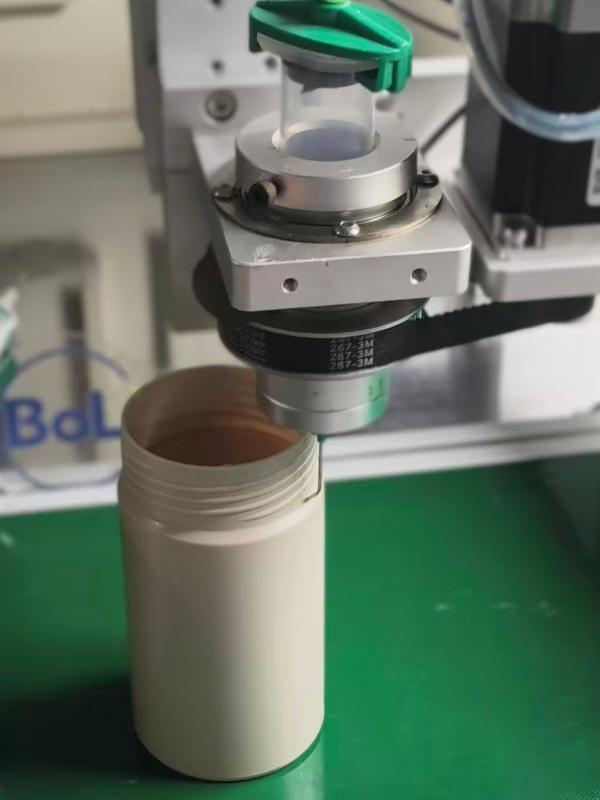
II. Simple curved surfaces: Z-axis height following is enough
For regular curved surfaces such as arcs and cylindrical side surfaces, a five-axis setup is not necessarily needed. Using Z-axis height following,Laser height measurement or contact height measurement; the equipment measures the operation-area height in real time and automatically compensates the Z-axis, keeping the distance between the needle tip and the surface constant, so the glue line will not string or pile up due to height differences. This type can be done on the basis of 3-axis plus Vision positioning, with controllable cost, and is a practical solution for many manual-machine-shell and frame dispensing.
III. Complex 3D curved surfaces: four-axis synchronized normal following
multi-angle inclined surfaces and three-dimensional irregular parts, the needle must “turn over” by itself. The four-axis coordination adds an R rotary axis to the dispensing machine X, Y, Z linear axes; the R axis lets the needle rotate around itself, tilting left and right, keeping the nozzle perpendicular to the curved surface. The core technology is RTCP, which ensures the dispensing head posture is constant during multi-axis coordination, dispensing while flipping, and the trajectory always fits the product. This is the standard practice for complex spatial glue paths. RTCP keeps the needle tip always aligned with the curved-surface tangent point, with smooth trajectory and consistent glue path, which is exactly the core value of four-axis relative to three-axis., the needle must 'turn itself around'. Four-axis synchronized motion adds an R-axis rotary axis beyond the dispensing machine's X, Y, Z linear axes; the R-axis makes the needle rotate around itself and tilt left/right, keeping the nozzle always perpendicular to the curved surface. The core technology is RTCP, which ensures the dispensing-head posture stays constant during multi-axis synchronized motion, dispensing while flipping, with the trajectory always fitting the product. This is the standard approach for complex spatial glue paths. RTCP keeps the needle tip always aimed at the curved-surface tangent point, with smooth trajectory and consistent glue path—precisely the core value of four-axis over three-axis.
IV. 3D Vision: keeping positioning up to speed
. 3D vision uses line laser scanning to generate point clouds, reconstruct the product's 3D profile, automatically identify dispensing feature edges and correct in real time. Combined with motion control, the workpiece does not need precise positioning, or even complex tooling; vision automatically finds and compensates. In industry solutions, four-axis plus 3D vision can control glue-path width fluctuation very small, and efficiency is much higher than stepwise multiple fixturing. For deep cavities and sidewalls where the human eye is hard to align, 3D vision's automatic correction is especially critical.. 3D Vision uses line laser scanning to generate point clouds, reconstructing the product's 3D contour, automatically recognizing dispensing-feature edges and correcting in real time. With motion control, the workpiece needs no precise positioning or even complex fixtures; Vision automatically finds position and compensates. In industry solutions, four-axis plus 3D Vision can control glue-path width fluctuation very small, and efficiency is much higher than stepwise multiple clamping. For deep cavities and side walls where the human eye has difficulty aligning, 3D Vision's automatic deviation correction is especially critical.
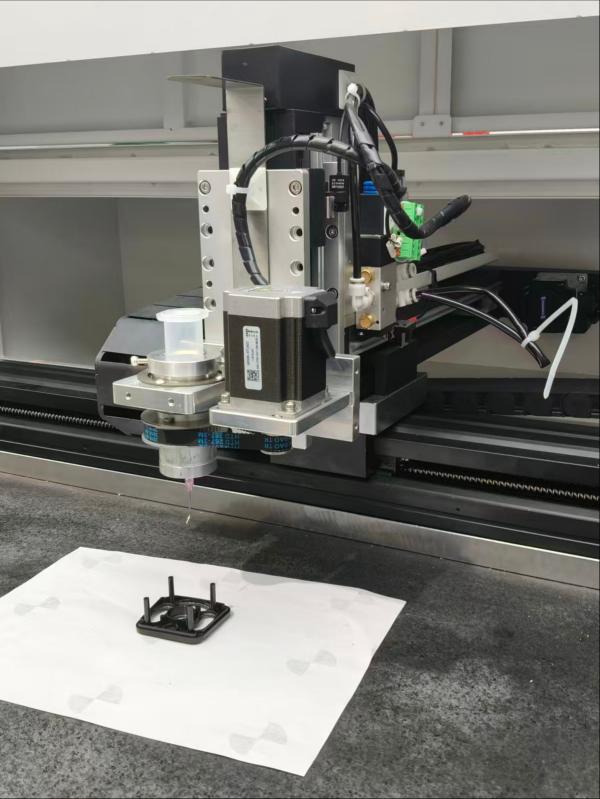
Bolli vision dispensing machines are equipped with Hikvision cameras and self-developed light sources; the multi-axis platform can undertake the process gradient from Z-axis following to multi-axis coordination. Whether to go four-axis, and whether vision uses 2D or 3D, depends on product curved-surface complexity and precision requirements. When unsure, Bolli provides free sample testing, sending the actual curved part for machine trial; which solution has more uniform glue path and better cycle time, the sample data directly gives the conclusion; after receipt, there is also unlimited remote after-sales guidance for parameter debugging.
Bolli's vision dispensing machine is equipped with Hikvision cameras and self-developed light source; the multi-axis platform can handle the process gradient from Z-axis following to multi-axis synchronized motion. Whether to use four-axis, and whether Vision is 2D or 3D, depends on the product's curved-surface complexity and precision requirements. When unsure, Bolli provides free sample testing; send the actual curved part to the machine, and the sample data directly leads to a conclusion on which solution gives more even glue path and better cycle; after manual handling there is also unlimited remote after-sales to guide parameter debugging.